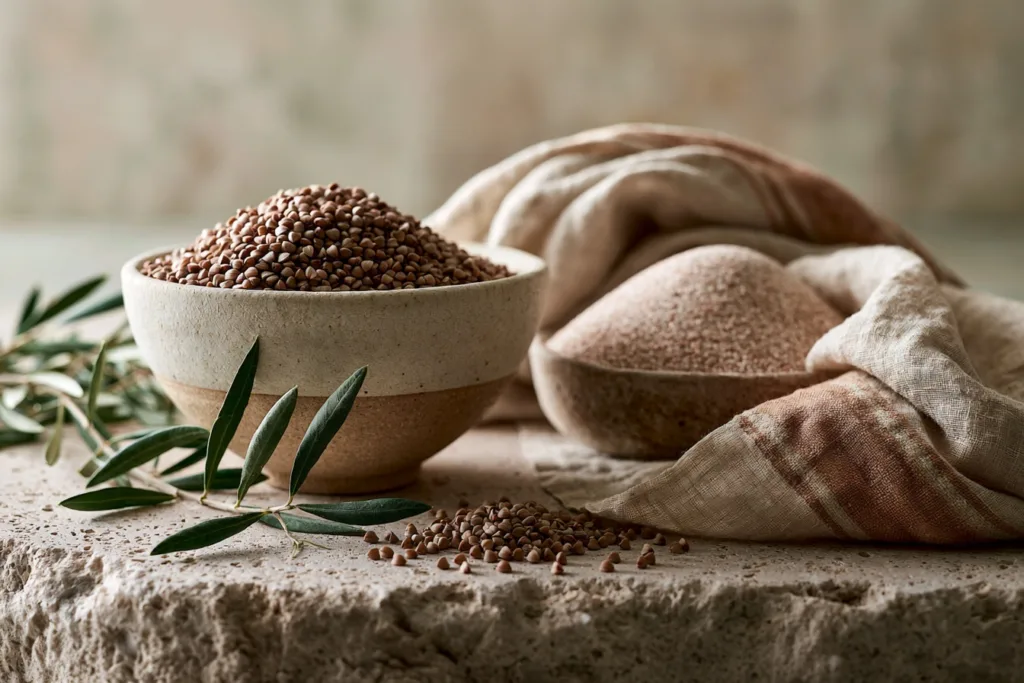
One of the most misunderstood ingredients… and one of the most rewarding Few ingredients have suffered quite so much from their name. Because despite being called buckwheat, it isn’t wheat. And it doesn’t contain gluten. In fact, it isn’t even a cereal. Buckwheat is what’s known as a pseudocereal, much like quinoa. It has been cultivated across Asia and Europe for centuries, long before anyone talked about gluten-free diets, and has always held a respected place in traditional cooking. It may not be the best-known grain. But it is certainly one of the most remarkable. An ingredient with real character Some ingredients quietly blend into the background. Buckwheat isn’t one of them. It has a distinctive toasted flavour with gentle nutty notes that bring depth and complexity to baking. That’s exactly why we love it. It doesn’t try to imitate wheat. It celebrates being something entirely different. Why we love it At Milola, every ingredient has to earn its place. Buckwheat does so in many ways. Naturally gluten-free: Buckwheat is naturally gluten-free, making it an excellent choice for people living with coeliac disease or anyone wanting to enjoy a broader variety of grains. Rich in fibre: Its natural fibre supports healthy digestion and helps keep you feeling satisfied for longer. A complete plant protein: Buckwheat is unusual among plant foods because it naturally contains all nine essential amino acids. That makes it a particularly valuable source of plant-based protein within a balanced diet. Naturally rich in minerals and antioxidants: Buckwheat provides important minerals including magnesium, iron and copper. It also contains rutin, a naturally occurring antioxidant that has been widely studied for its potential role in supporting cardiovascular health. Much more than a gluten-free alternative For many years, buckwheat has been treated simply as a replacement for wheat. We think it deserves much more than that. Its value doesn’t come from what it lacks. It comes from everything it brings. Flavour. Texture. Character. And a culinary identity entirely its own. How to cook with buckwheat Buckwheat is remarkably versatile. You’ll find it both as whole groats and as flour. It’s wonderful in: Artisan breads. Cookies. Cakes. Pancakes. Crêpes. Warm salads. Soups. Grain bowls. In Brittany, it’s the star ingredient of traditional savoury galettes. In Japan, it is the main ingredient in soba noodles. Across Eastern Europe, it has been enjoyed for generations as an everyday staple. Few ingredients have travelled so widely. Why we use buckwheat at Milola Because it brings exactly what we’re looking for. A delicate texture. A rich, distinctive flavour. And the kind of complexity that makes our recipes taste like something far more interesting than “gluten-free cookies.” We’re not trying to recreate traditional recipes without wheat. We want to create other new ones that are just as good (or better). Buckwheat helps us do exactly that. A small celebration of buckwheat Sometimes the finest ingredients are the ones that never try to be something else. Buckwheat doesn’t try to be wheat. And perhaps that’s its greatest strength. It has nourished people for thousands of years. It has travelled across cultures and cuisines. And it reminds us that true culinary diversity often begins with something beautifully simple. At Milola, buckwheat is part of our recipes because we believe great cooking isn’t about replacing. It’s about discovering.
One of the world’s most familiar grains… and one of its most overlooked Some ingredients hardly need introducing. Rice is certainly one of them. For thousands of years, it has nourished cultures across every continent. Yet one version of it often receives far less attention than it deserves. Brown rice. And we believe it deserves considerably more prominence. Not because it’s fashionable. But because it preserves much of what makes the grain so valuable in the first place. What makes brown rice different? The difference is surprisingly simple. White rice is produced by removing the outer layers of the grain, brown rice keeps them. That means it retains the bran and the germ, where much of the fibre, vitamins, minerals and naturally occurring antioxidants are found. Although both come from exactly the same grain, their nutritional profiles are remarkably different. Why we love it At Milola, we never choose an ingredient for just one reason. It has to contribute flavour. Texture. And purpose. Brown rice does all three. Naturally gluten-free. Brown rice is naturally gluten-free, making it an excellent choice for people living with coeliac disease or anyone looking to enjoy a wider variety of grains. Rich in fibre. Because it keeps its bran layer, brown rice contains considerably more fibre than white rice. That supports healthy digestion and helps you feel satisfied for longer. Slow, steady energy. Like many whole grains, brown rice releases its carbohydrates more gradually than refined grains. The result is a steadier source of energy throughout the day. Naturally rich in vitamins and minerals. Brown rice provides important minerals including magnesium, phosphorus and selenium, as well as B vitamins that support many essential metabolic functions. Naturally occurring antioxidants. The bran also contains antioxidant compounds that help protect the body’s cells from oxidative stress. A simple flour with extraordinary potential It’s easy to assume the most sophisticated ingredients are always the most interesting. We don’t think that’s true. A beautifully milled brown rice flour can be something rather special. Especially when it comes from exceptional grain and is produced with care. The brown rice flour we use at Milola comes from Valencia, on Spain’s Mediterranean coast. Whenever possible, we choose ingredients that are both exceptional in quality and close to home. Every ingredient in our recipes has earned its place. Why we use brown rice in our cookies Because it contributes far more than structure. It creates a delicate texture. A gentle flavour that allows the other ingredients to shine. And a nutritional profile that reflects the way we believe food should be made. We’re not trying to make “gluten-free products.” We’re trying to create recipes so delicious that gluten simply stops being the most interesting thing about them. In defense of brown rice For many years, brown rice has been seen mainly as “healthy food.” We think it deserves a better reputation. It’s remarkably versatile. Elegant in its simplicity. Nutritious. And capable of bringing real character to a recipe when treated with care. That’s why it appears in so many of our bakes. Because the finest ingredients aren’t always the rarest ones. Sometimes they’re the ones we’ve known all our lives… We simply needed to learn to see them differently.
The story behind Milola By Manuela García, Founder of Milola. “I dreamed of creating a place where no one would ever feel left out of the table.” Some moments quietly change the course of your life. Mine happened almost thirty years ago, while I was living in London. For as long as I could remember, I’d lived with fragile health. Allergies. Digestive problems. Constant discomfort. Medication. It had become so normal that I assumed it was simply part of who I was. Until one doctor asked a different question. And changed the way I ate forever. He removed gluten, dairy and several other foods from my diet. Almost overnight, my health improved. But something else disappeared too. A great deal of the joy I had always found in food. When food stops being about sharing Today it’s difficult to imagine what that meant. There was no Google. No social media. No food blogs. Hardly any gluten-free products. The tiny free-from shelf at the supermarket was disappointing at best. At the time, I was working in a beautiful French pâtisserie in Chelsea. Every morning we prepared some of the most exquisite pastries I’d ever seen. And I couldn’t eat almost any of them. That’s when I realised something I’ve never forgotten. Food is never just food. It’s celebration. Family. Friendship. Culture. Travel. Care. And when you can’t fully take part in those moments, it doesn’t simply feel like you’ve changed your diet. It feels as though you’ve been left out of something much bigger. Starting again I became obsessed with learning. I spent hours in libraries trying to understand what gluten actually was. I wandered through London’s markets discovering ingredients I’d never encountered before. I realised the world was so much bigger than wheat. Sorghum in Indian cooking. Millet and quinoa in Latin American cuisine. Teff in Ethiopian food. Buckwheat. Tapioca. Psyllium. Then came the experiments. There were plenty of failures. More than I can count. But slowly, something began to change. The recipes no longer felt like substitutes. They were simply… delicious. The idea that became Milola Eventually I realised I wasn’t trying to make gluten-free food. I was trying to recover something much more important. The feeling of sitting around a table without feeling different. Without explaining yourself. Without compromising. Without settling for a second-rate version of what everyone else was enjoying. That’s how Milola began. Not as a cookie brand. Not as a bakery. But as an idea. To create a place where everyone belongs around the table. Mediterranean at heart I was born on the Mediterranean coast. In a family where every meaningful conversation happened around the table. Where cooking was an act of love. And sharing food was simply how we cared for one another. That’s why I’ve never believed we have to choose between wellbeing and pleasure. I believe the two belong together. It’s the question that still guides every recipe we create. How can something taste genuinely wonderful and also make you feel good? From one small bakery to thousands of tables For many years that idea lived inside a small bakery in Mataró, near Barcelona. Something extraordinary happened there. Every weekend, families travelled from all over Spain. They didn’t come just to buy a cake. They came because, for a few hours, they could stop asking what they were allowed to eat. They could simply enjoy being together. That experience confirmed everything we believed. Today our products are made in a much larger bakery so they can reach thousands of homes. But the idea remains exactly the same. What Milola stands for We don’t believe anyone should have to choose between health and pleasure. Between nourishment and indulgence. Between taking care of themselves and celebrating life. We believe great food can bring all of those things together. Most of all, we believe no one should ever feel like the odd one out around the table. Because being excluded from a generous table is, in many ways, being excluded from life itself. And that’s still the reason we switch on our ovens every single morning.
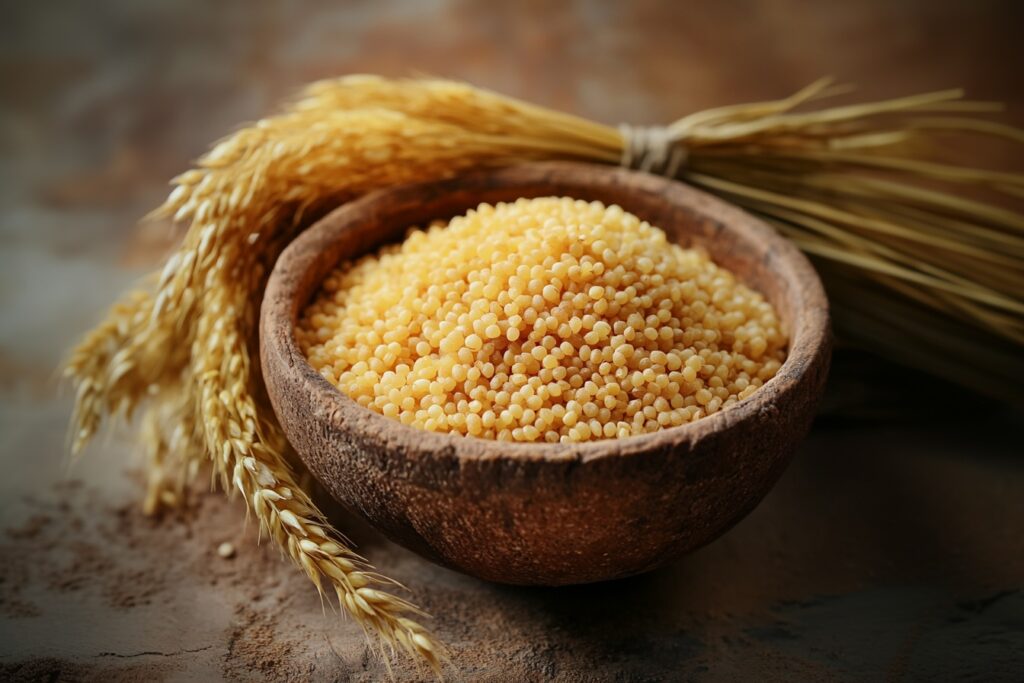
A tiny grain with thousands of years of history Ask someone to name a few grains and you’ll probably hear the same answers. Wheat. Rice. Corn. Oats. Maybe quinoa. But there’s another grain that has nourished millions of people for thousands of years and still remains surprisingly unfamiliar to many of us. It’s called millet. And we think it deserves far more attention than it gets. An old favourite in many parts of the world Millet has been cultivated across Africa and Asia for thousands of years. For generations, it has been an everyday staple for one simple reason: It’s nourishing. Resilient. Versatile. And remarkably enjoyable to cook with. It may not be the world’s most famous grain. But it’s certainly one of its oldest. Why we love it At Milola, every ingredient earns its place. Millet ticks many of the boxes we look for. Naturally gluten-free Millet is naturally gluten-free, making it an excellent choice for people with coeliac disease or anyone looking to bring greater variety to the grains they eat. Rich in nutrients It provides complex carbohydrates, fibre, plant protein and important minerals such as magnesium, phosphorus and iron. It also contains B vitamins and naturally occurring antioxidants. It’s not a miracle food. But it is a genuinely nutritious ingredient that deserves a place in a balanced diet. Easy to digest Its fibre supports healthy digestion and contributes to a healthy gut. Like many whole grains, it also helps keep you feeling satisfied for longer. Slow, steady energy Compared with many refined grains, millet has a relatively low glycaemic index. That means it releases energy more gradually, helping to avoid dramatic spikes in blood sugar after meals. Better for the planet too There’s another reason we’re so fond of millet. It’s an incredibly resilient crop. It needs less water than many other grains. It copes well with drought. And it thrives in places where more demanding crops struggle. As agriculture adapts to a changing climate, traditional grains like millet are becoming increasingly relevant once again. By incorporating millet into our cookies, we also support more environmentally friendly agriculture. How to cook with millet If you’ve never cooked millet before, you’ll probably be surprised by how versatile it is. Try it in: Warm salads. Grain bowls. Soups. Stews. Porridge. Veggie burgers. You can cook it much like rice or quinoa. Its flour also works beautifully in gluten-free breads, cakes and baking. Why we use millet at Milola Because we like our recipes to taste good. Because we want every ingredient in our recipes to contribute something meaningful. Millet brings flavour. A delicate, tender texture. And a unique personality that combines very well with other Mediterranean ingredients. We’re not trying to imitate wheat. We’re far more interested in discovering everything other grains have to offer. A small defence of millet For a very long time we’ve expected one grain to do almost everything. Bread. Pasta. Flour. Cookies. Pastries. Perhaps it’s time to rediscover the extraordinary diversity that has always existed. Not to replace one grain with another. But to welcome more variety back to our tables. Millet has nourished people for thousands of years. We’re delighted that it can now become part of ours too.
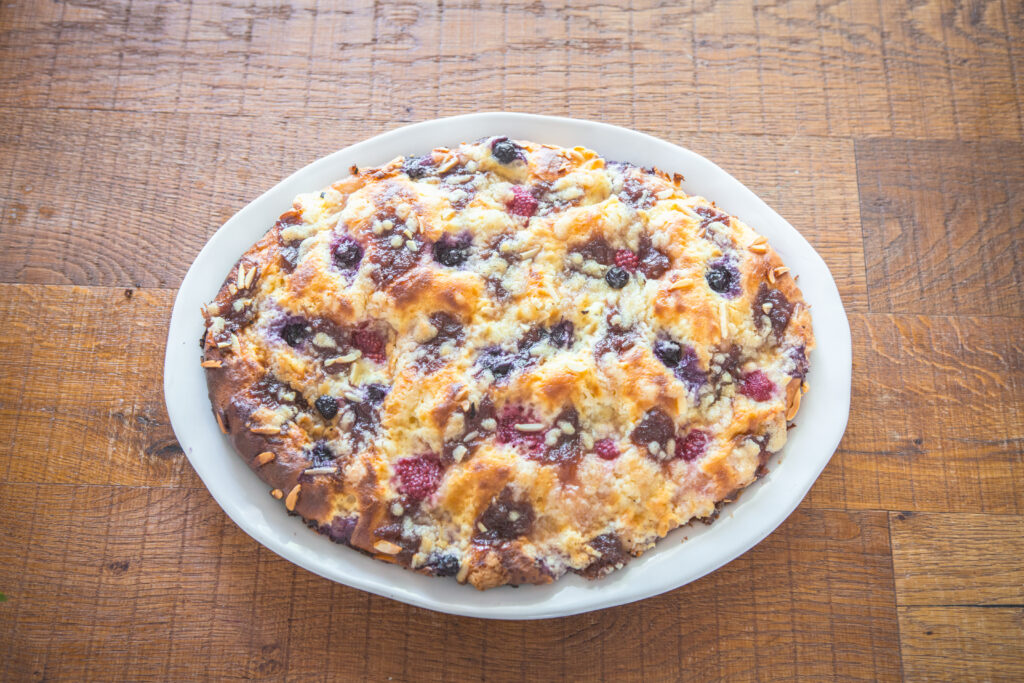
The pastry that announced the arrival of summer. Some recipes feed us. Others become part of a family’s story. This Sant Joan “Coca”, the catalan name for this pastry, belongs firmly in the second category. During the years we ran our bakery in Barcelona, we baked hundreds of cocas every June. And every Sant Joan Eve, something happened that never stopped feeling special: families would queue to take one home for the celebrations ahead. These were the cocas that meant summer had officially begun. Generous. Festive. Beautiful. The kind that sits proudly at the centre of the table while someone opens a bottle of cava, children run through the garden and conversations drift long into the warm Mediterranean night. The softness of a carefully nurtured sourdough, the richness of mascarpone and the bright acidity of rhubarb did the rest. A subtle floral note of hibiscus was the final touch that brought everything together. Even today, making it at home takes us back to those evenings of fairy lights, distant fireworks and tables shared with friends and family. The most magical night of the summer If you’re unfamiliar with Sant Joan, think of it as Catalonia’s midsummer celebration. Part festival, part family gathering, part unofficial beginning of summer. For us, it has always been one of the most special nights of the year. The night when summer truly begins. The night that smells of the sea, fireworks and warm air after sunset. We love hanging lights in the garden, setting long tables outdoors and watching the evening slowly fill with laughter, conversation and moments that quietly become memories. And if there’s one thing that never fails to appear on that table, it’s a good coca. A different kind of “coca” Traditional Sant Joan Coca will always hold a special place in our hearts. But over the years, we wanted to create a version of our own. A coca made with gluten-free sourdough. More aromatic. More complex. Full of character. A coca where the richness of mascarpone and crème fraîche could meet the gentle acidity of rhubarb in perfect balance. The result became one of the most loved recipes in our bakery. Today, we’d like to share it with you. Ingredients for the dough: 250 g of your favourite gluten-free flour blend 30 g psyllium husk (omit if your flour blend already contains psyllium or xanthan gum) 75 g softened butter or plant-based margarine 40 g cane sugar or white sugar 30 g maple syrup 1 whole egg plus 1 egg yolk (reserve the white for glazing) Zest of 1 lemon Zest of 1 orange 1 tablespoon orange blossom water 2 teaspoons honey 1 teaspoon fine sea salt 25 ml warm milk or plant-based milk (we usually use oat milk) 100 g gluten-free sourdough starter (you can find a step by step recipe for our sourdough here). Ingredients for the filling: 110 g mascarpone 110 ml crème fraîche ¼ teaspoon vanilla extract 25 g icing sugar or maple syrup Rhubarb compote: Here’s the recipe. To decorate: The reserved egg white A splash of milk or plant-based milk Sugar Flaked almonds or pine nuts Fresh raspberries Fresh blueberries Optional: Homemade crumble (recipe below) Method: 1. Prepare the dough: In a large bowl (or a stand mixer), combine the warm milk, whole egg, egg yolk, orange blossom water, honey and salt. Add the softened butter, sugar and maple syrup. Mix in the sourdough starter until fully incorporated. Add the flour and knead until the dough becomes smooth and uniform. If using a Thermomix, blend for 30 seconds on speed 6 before kneading for 4 minutes using the dough setting. If using a Thermomix, knead for 4 minutes on the Dough setting. 2. Slow fermentation Transfer the dough to a lightly greased bowl. Cover and refrigerate for at least 12 hours. This step requires patience, but it makes an enormous difference to the flavour, texture and complexity of the finished coca. The best doughs are rarely in a hurry. 3. Shape the coca: Remove the dough from the fridge and knead briefly once more. If working by hand, lightly oil your hands and the baking paper to make handling easier. Shape the dough into the traditional oval coca or spread it over a baking tray for a more rustic finish. Shape the dough into the traditional oval loaf, or simply spread it out on a baking tray. Leave it to prove for another hour somewhere warm. 4. Prepare the mascarpone cream: Whisk the mascarpone until smooth. Add the crème fraîche, vanilla and icing sugar. Continue whisking until the mixture thickens enough to hold its shape. Keep refrigerated until needed. 5. Decorate the Coca: Mix the reserved egg white with a splash of milk and brush around the edges of the dough. You have two options: Full topping: Spread the mascarpone cream across the surface of the coca, leaving a border around the edge. Top with the rhubarb compote. Traditional decoration: Using your fingertips, gently press diagonal lines into the dough. Pipe the mascarpone cream along these lines. Fill the remaining spaces with the rhubarb compote. Finish with fresh raspberries, blueberries and either flaked almonds or pine nuts. If you like, sprinkle over some homemade crumble for extra texture. 6. Bake: Place the coca in a cold oven. Set the temperature to 170°C (340°F). Bake for 45 to 55 minutes. Use bottom heat only for the first 10 minutes if your oven allows. Then continue baking with both top and bottom heat. If the coca begins browning too quickly, loosely cover it with foil until fully baked. How we like to serve it. We love serving this coca slightly warm or at room temperature. Perfect with: Freshly brewed coffee. A chilled glass of cava. Fresh summer fruit. Or simply good company. Because some recipes don’t need much more than that. No sourdough starter? You can make a quick starter instead. Quick starter: 25 g chickpea, sorghum or brown rice flour. 25 g buckwheat flour. 50
The ingredient we used to cross the border for. Some ingredients are simply discovered. Others quietly become part of your life. That’s exactly what happened with rhubarb. I first fell in love with it while living in England. Every spring it would appear in markets, bakeries and family kitchens as though it had always belonged there. Its flavour stayed with me. Bright. Tangy. Elegant in its simplicity. Unlike anything I’d tasted before. Years later, when we opened our bakery in Spain, I simply couldn’t imagine spring without it. So every year, as soon as rhubarb came into season, I’d drive across the French border to Perpignan and fill the car with fresh stalks. Back at the bakery we’d cook huge batches of compote that would last us for months. That compote became the heart of one of Milola’s most loved Coca de Sant Joan recipes — the traditional sweet bread that marks the arrival of summer across Catalonia. Families came back for it year after year. For many of them, it simply wasn’t Sant Joan without it. A wonderful ingredient waiting to be discovered While rhubarb has been part of Northern European baking for centuries, it’s still surprisingly uncommon in Spain. Fortunately, it’s becoming easier to find through specialist greengrocers and online suppliers. Nosotros solemos comprarlo en Fruites i Verdures Giró, en el Mercat de Sant Antoni. If you’ve never cooked with rhubarb before, this is a wonderful place to begin. And if you can, make a little extra. You’ll thank yourself when we use it in another very special recipe. So much more than a topping. Although this compote became famous in our bakery thanks to our Coca de Sant Joan, it quickly found its way into countless other recipes. We love serving it with: Yogurt (dairy or plant-based) Granola. Porridge. Cheesecakes. Fruit tarts. Muffins. Brioche. Chocolate mousse. Toast with butter or nut butter. Its balance of sweetness, gentle acidity and floral notes makes it one of those preparations you’ll always be happy to find waiting in the fridge. Ingredients: 1 kg fresh rhubarb 200 g raw cane sugar 10 dried hibiscus flowers 1/2 teaspoon vanilla extract (optional) 1 teaspoon ground ginger (optional) 2 star aniseed pods Method: 1. Prepare the rhubarb Wash the rhubarb thoroughly and trim both ends. If the stalks are particularly thick, slice them lengthwise before cutting them into roughly 2 cm pieces. Set aside about 200 g and place the rest in a heavy-based saucepan. 2. The first cook Add the sugar and dried hibiscus flowers. The hibiscus deepens the colour beautifully while adding delicate floral notes that complement rhubarb’s natural tartness. Stir gently. Cover the pan and cook over a low heat for around 15 minutes, until the rhubarb begins releasing its juices. 3. Build the texture Remove the lid and increase the heat slightly. Add the reserved rhubarb pieces. This keeps part of the fruit intact, giving the finished compote a far more interesting texture. Continue cooking for another 15 minutes. It’s ready when you can draw your finger across the back of a spoon and the line stays clean. 4. Cool Transfer the compote to a large bowl. Once cool, remove the hibiscus flowers. It’s ready to enjoy. How to store it: The compote keeps beautifully in an airtight container in the refrigerator for several days. It also freezes exceptionally well. In fact, that’s exactly what we used to do every spring so we could enjoy rhubarb long after the season had finished. A small defence of rhubarb – We have a soft spot for ingredients that still manage to surprise people. Rhubarb is one of them. It doesn’t try to taste like strawberries. Or apples. Or plums. It has a character entirely its own. Perhaps that’s why it pairs so effortlessly with vanilla, citrus, strawberries, chocolate and hibiscus. If you’ve never cooked with rhubarb before, we hope this recipe marks the beginning of a long friendship. Because some recipes belong to a season. Others stay with you for life. You can watch a video of the recipe step by step here.
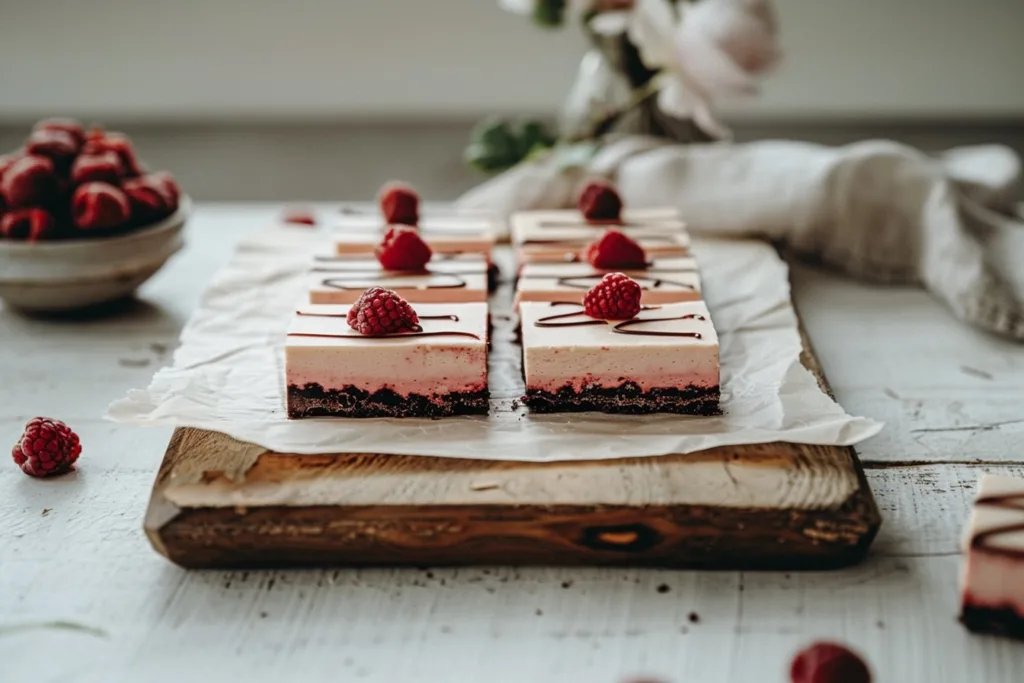
The recipe that can’t decide whether it wants to be bars or a cake. Some recipes arrive knowing exactly what they want to be. And then there are these. Technically, they’re bars. But change the tin and suddenly they become a rather spectacular cake. We prefer to think they’re simply adaptable. An impromptu afternoon treat. Dinner with friends. A birthday celebration. Or an ordinary Tuesday that deserves improving slightly. They work remarkably well in every situation. An unexpectedly good combination. Chocolate and raspberries have been getting along beautifully for decades. No surprises there. But then come the cashews. The coconut. The orange. And one unexpected guest: beetroot. It brings colour, moisture and a depth that’s surprisingly difficult to describe and very easy to enjoy. Some recipes turn out to be far better than their ingredient list has any right to suggest. This is one of them. Ingredients for the base: 160g of Milola Double Chocolate and Banana cookies 120 g almond flour 40 g melted coconut oil Ingredients for the filling: 240 g cashews soaked overnight or for 20 minutes in hot water 120 g coconut cream (the thick part from a tin of coconut milk) 50 g melted coconut oil 60 g maple syrup 125 g fresh raspberries 50g of raw beetroot 1/2 teaspoon vanilla extract Zest of one orange To decorate: Melted dark chocolate Method – 1. Prepare the base: Preheat the oven to 180°C (350°F). Blend the cookies, almond flour and coconut oil until the mixture resembles damp sand. Press firmly into your chosen tin. Rectangular for bars. Round for cake. We’re not here to judge. Bake for approximately 10 minutes. Remove from the oven and allow to cool completely. 2. Prepare the filling: Drain the cashews well and place them in a food processor. Add the coconut cream, coconut oil, maple syrup, raspberries, beetroot, vanilla and orange zest. Blend for several minutes until the mixture becomes completely smooth and silky. Patience is rewarded here. 3. Assemble and chill: Pour the filling over the cooled base and smooth the surface. Refrigerate for at least three to four hours until firm. Or overnight if you’re one of those admirable people capable of waiting. We rarely are. 4. The finishing touch: Drizzle with melted dark chocolate. Cut into bars or slices. Serve cold. And accept compliments gracefully. Variations we love Swap the raspberries for strawberries or mixed berries. Add chopped pistachios for extra texture. Serve with coconut yoghurt or plant-based crème fraîche. How we like to serve them: Very cold. With coffee. With a good cup of matcha tea. With a very cold glass of cava. Or directly from the fridge at eleven o’clock at night while promising ourselves this will definitely be the last piece. A small defence of beetroot Beetroot has something of an image problem. Most of us associate it with salads and not much else. But when it meets chocolate, something rather extraordinary happens. It brings moisture. Depth. And a complexity that’s difficult to identify but impossible to ignore. Perhaps that’s why beetroot has quietly found its way into some of the world’s best chocolate cakes. And perhaps that’s why these bars disappear considerably faster than they should. If you make them, we’d love to know whether they ended up as bars or cake. We hope you enjoy this recipe as much as we do. If you’d like to see a video tutorial, you can watch it here. Enjoy!
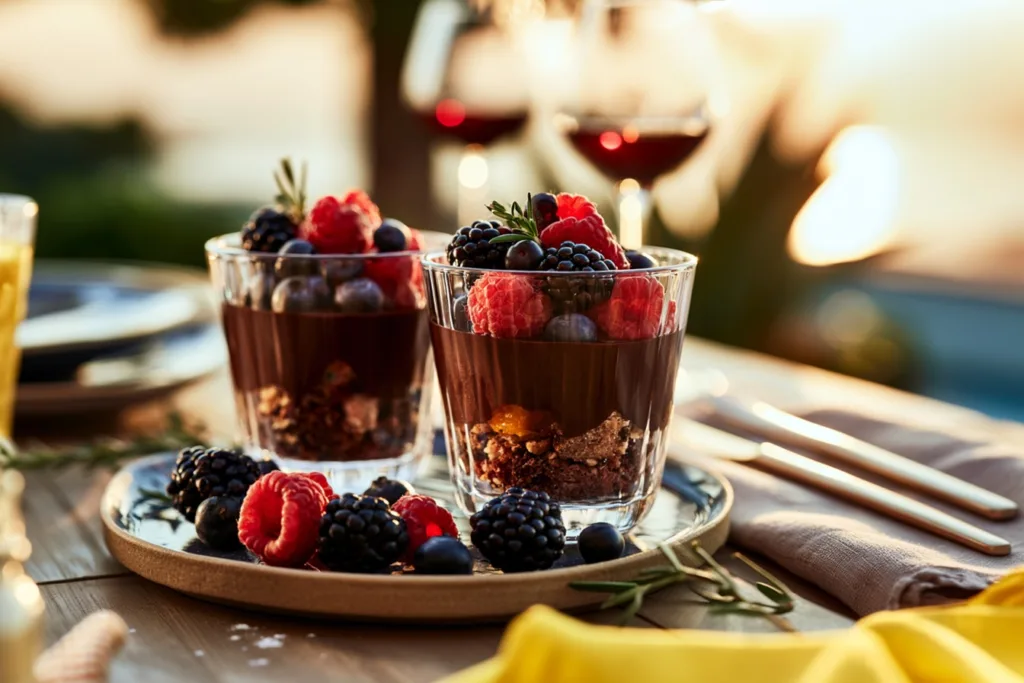
The dessert nobody guesses is made with tofu. Some ingredients have excellent press. And then there’s tofu. Possibly one of the most misunderstood ingredients in modern cooking. Because when it appears in a chocolate mousse like this, something rather amusing happens: Nobody sees it coming. All they notice is chocolate. Lots of chocolate. A silky, surprisingly light texture. And that wonderful feeling of eating something deeply indulgent that just happens to be plant-based and dairy-free. A small pastry chef’s secret. Silken tofu has an extraordinary ability to disappear. Not literally, of course. But it does have a remarkable talent for becoming whatever surrounds it. In this case, it becomes the perfect partner for dark chocolate. It brings creaminess. Lightness. And a texture that feels far closer to a classic French mousse than most people would ever expect. Ingredients: 340 g dark chocolate 340 g silken tofu (important: silken, not firm) 60 g soy milk 2 tablespoons maple syrup 1 teaspoon vanilla extract (optional) To serve: Milola Orange, Almond & Cardamom Cookies Fresh berries Si prefieres una versión completamente vegana, puedes utilizar nuestra galleta de Doble Chocolate. Method: 1. Prepare the tofu. Break the tofu into a sieve and allow it to drain for a couple of hours to remove excess moisture. This small step makes a surprisingly big difference to the final texture. 2. Melt the chocolate. Melt the chocolate gently using a bain-marie or short bursts in the microwave. Allow it to cool slightly before using. 3. Make the mousse. Place the drained tofu, soy milk, maple syrup and vanilla into a blender. Blend until completely smooth and silky. Add the melted chocolate and blend again until the mousse becomes glossy and perfectly uniform. That’s it. How we like to serve it. We love breaking some Orange, Almond and Cardamom cookies into the bottom of a glass and alternating layers of cookie and mousse. The richness of the chocolate, the perfume of citrus and cardamom and the freshness of the berries do the rest. Finish with a whole cookie and a few fresh berries on top. It looks like the sort of dessert you’d order in a restaurant. And yet it probably took less time to make than choosing what to watch after dinner. A small lesson about chocolate – Chocolate has an extraordinary ability to make people happy. We’re not aware of any scientific studies proving it. But we’re not aware of many people willing to argue the point either. And this mousse probably won’t help settle the debate. If you make it, we’d love to hear how long it survives in your fridge.
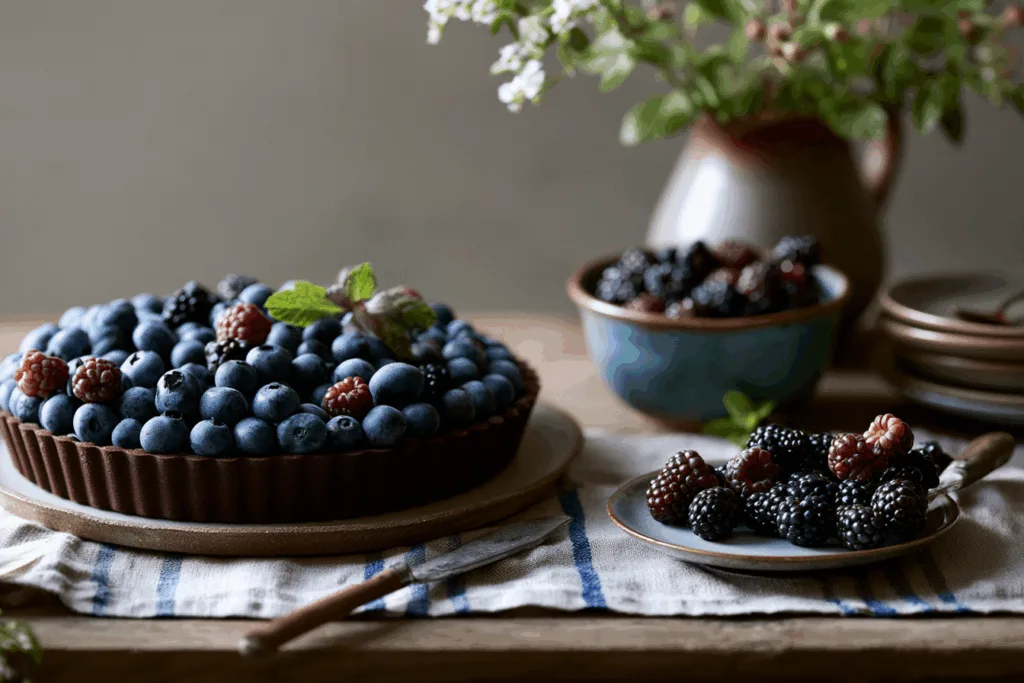
A summer tart that’s as easy to make as it is hard to share. Some desserts impress because of the technique behind them. Others impress because nobody expects something so simple to taste quite this good. This tart firmly belongs in the second category. The richness of a dark chocolate cookie base. The bright acidity of blueberries and lime. The creaminess of coconut. And that almost foolproof combination of fruit and chocolate that has been making people happy for generations. It’s also vegan, gluten-free and surprisingly easy to make. Every good tart starts with a good biscuit We like to think that some recipes begin long before you turn on the oven. They begin with an ingredient that’s already good enough to stand on its own. In this case, everything starts with our Double Chocolate and Banana cookies. Rich. Chocolatey. Slightly fudgy. The sort of biscuit that’s perfectly happy being eaten straight from the packet. But generous enough to become the base of something entirely different too. Ingredients: For the base: 250 g Milola Double Chocolate and Banana cookies. 110 g coconut oil. For the filling: 375 g blueberries. 250 g coconut milk. 240 g coconut yogurt. 70 g maple syrup. 1 tsp agar agar. Zest of 1 lime. 1/4 teaspoon salt. To decorate: Raspberries Fresh figs Blueberries Strawberries Fresh mint leaves Lime wedges Method: 1. Prepare the base: Preheat the oven to 180°C (350°F). Lightly grease your tart tin with coconut oil and place it in the fridge. Crush the cookies into fine crumbs and mix them with the melted coconut oil. Press the mixture firmly into the base and sides of the tin. Bake for approximately 12 minutes. Leave to cool while you prepare the filling. 2. Prepare the filling: Blend the blueberries and coconut milk until smooth. For an especially silky texture, pass the mixture through a sieve. Transfer to a saucepan and add the agar agar. Bring gently to the boil and cook for two to three minutes, stirring continuously. Reduce the heat and stir in the maple syrup, coconut yogurt, lime zest and salt. Cook for one more minute over a low heat. Remove from the heat and allow to cool slightly. 3. Assemble the tart: Pour the filling over the biscuit base. Refrigerate for at least four hours to allow the tart to set properly. Good things tend to reward patience. 4. Decorate: Just before serving, decorate with fresh fruit, mint leaves and lime wedges. It doesn’t need much more than that. How we like to serve it: Cold. Very cold. With coffee. With tea. With a very cold glass of cava. Or simply on a table full of people you’d quite like to impress. It works remarkably well in all four situations. If you want to see a video of the recipe step by step, you can do so here. A small lesson about chocolate Some ingredients demand attention. Y otros que saben hacer que todo lo que tienen alrededor sea mejor. Chocolate somehow manages to do both. Perhaps that’s why it has remained irresistible for centuries. And perhaps that’s why this tart never lasts very long once it reaches the table. If you make it, we’d love to hear how long yours survives.
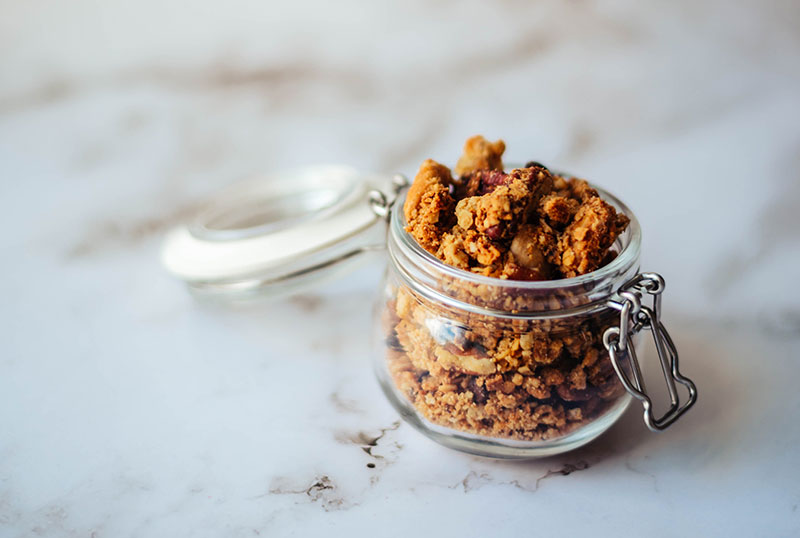
Crunchy, nourishing, gluten-free and made with ingredients you’d happily keep in your own pantry Some recipes come and go. Others become part of everyday life. This granola belongs firmly in the second category. For years, it has been part of our breakfasts, afternoon snacks and those in-between moments spent moving from meetings to ovens to new recipe ideas. It’s simple to make, packed with real ingredients and built around something we care deeply about: the belief that looking after yourself should never mean giving up pleasure. Naturally gluten-free, vegan-friendly and rich in protein and healthy fats from nuts, it’s one of those recipes that earns its place in your kitchen again and again. Dry ingredients: All the ingredients are accessible and can be easily found in any supermarket. 200 g gluten-free rolled oats. 130 g whole almonds. 110 g pecan nuts. 120 g almond flour. Wet ingredients: 130 g maple syrup. 60 g coconut oil or mild extra virgin olive oil. 60 g peanut butter Wet ingredients: Dark chocolate, roughly chopped Dark chocolate chips Before you begin: One of our favourite little tricks is leaving the almonds and pecans whole. We love finding those large crunchy pieces coated in maple syrup and peanut butter. It creates a far more interesting texture, and every spoonful feels slightly different from the last. Method: 1. Mix the dry ingredients: In a large bowl, combine the oats, almonds, pecans and almond flour. 2. Preheat the oven: Preheat your oven to 160°C. 3. Add the wet ingredients: Pour in the maple syrup, oil and peanut butter. Mix thoroughly until everything is evenly coated. 4. Bake: Spread the mixture evenly across a baking tray lined with parchment paper. Press it down gently with a spoon or spatula to create an even layer. Bake for approximately 25 minutes. Every oven is different, so keep an eye on it during the final few minutes to achieve your preferred level of golden crunch. When should you add the chocolate? You have two options: Add chocolate chips during the last few minutes of baking so that they partially blend into the mixture. Scatter chopped dark chocolate over the granola as soon as it comes out of the oven. The residual heat will melt it slightly, allowing you to stir it through and create delicate ribbons of chocolate throughout the mixture. Our personal favourite. You can watch the full recipe video here. How we like to enjoy it. Granola is one of those foods that never gets boring. Some of our favourite ways to enjoy it include: With coconut yogurt. With fresh seasonal fruit. Sprinkled over a smoothie bowl. With your favourite plant-based milk. As a topping for homemade fruit ice cream. Straight from the jar when nobody’s watching. How to store it: Once completely cooled, transfer the granola to an airtight glass jar. Stored in a cool, dry place, it will stay deliciously crunchy for several weeks. Avoid refrigerating it, as moisture can soften its texture. A small everyday revolution. When we talk about the philosophy behind Milola, we often say that one day we decided to rethink the way we eat. Not because we wanted to follow a trend. Not because we were searching for perfection. Simply because we believed that taking care of ourselves shouldn’t mean giving up the pleasure of good food. This granola was born from that same idea. Simple ingredients. Plenty of flavour. And the conviction that the best recipes usually begin with a thoughtfully stocked pantry. If you make it at home, we hope it becomes one of those recipes you find yourself returning to time and time again.
-10%
UNLOCK A 10% DISCOUNT ON YOUR FIRST PURCHASE!
Enter your email address to receive the discount coupon
in your inbox right away. You'll also receive exclusive offers and content
available only to subscribers.